

Estimated reading time: 5 minutes
You know the drill. A framework upgrade looks clean on the ticket until you hit the first async params contract change and the build lights up red at 2 a.m. I am running Claude Opus 4.8 inside Claude Code with RuFlo right now on exactly that kind of production Next.js 14-to-16 migration. Routing updates, dependency bumps, config cleanup, lint migration, test validation, the whole stack. All in all, it took 40 minutes to complete everything end to end.
Anthropic calls Opus 4.8 a modest but tangible improvement on 4.7, and that matches what I saw. The gains are real but incremental, the kind that compound on long agentic work rather than a generational leap.
Claude Opus 4.8 Dynamic Workflows Change How You Run Big Migrations
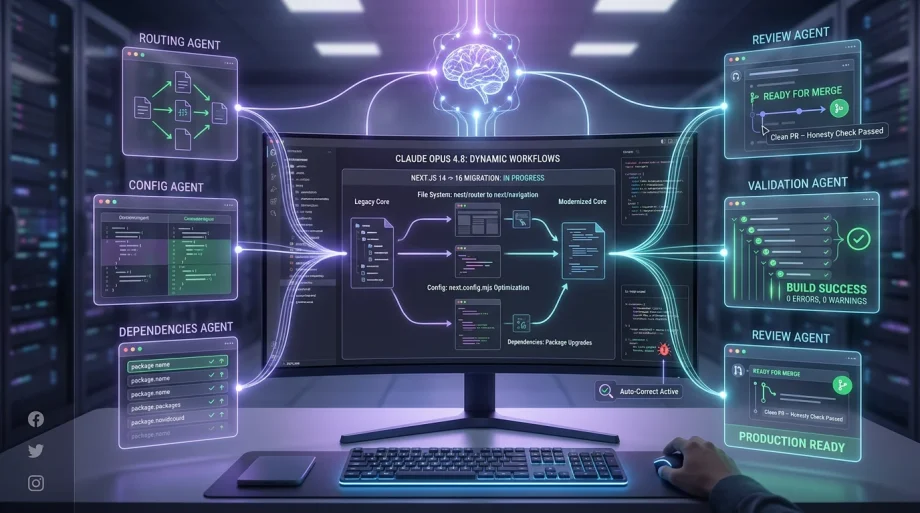
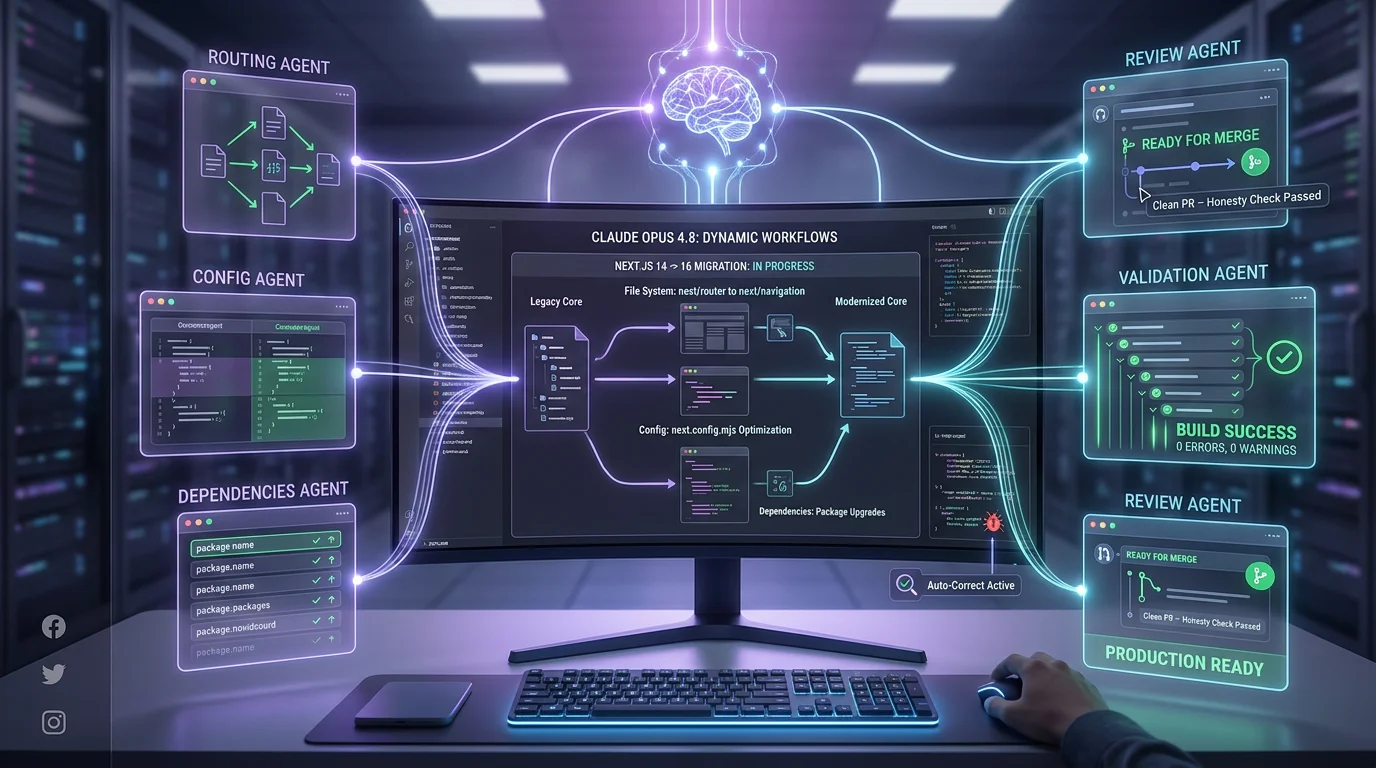
The real advance is how it plans and then spins up parallel subagents across different layers at once. To be clear, four agents are what this particular job needed, not the ceiling. Dynamic workflows can fan a task across hundreds of parallel subagents in a single session, and on Opus 4.8, those agents can run longer before reporting back. On this job, one agent handled the package bump and codemod. Another took the dynamic slug routes that needed the new Promise params pattern. A third cleaned up next.config and the lint script. A validator kept score on tests and builds. The coordinator kept the hand-offs straight without me babysitting every file.
I have done enough of these by hand to know the old way burns hours on context switching and missed side effects. Parallel execution plus verification before it reports back cuts that risk. It does not replace the final review. It just makes the first pass reliable enough that the review actually catches the important stuff.
Honesty Gains You Feel When Code Ships
The ~4× drop in missed flaws appears quickly when you are touching generateMetadata and page components across multiple dynamic routes. It flagged the old synchronous params pattern before any build ran. It stayed clear on what it had actually checked versus what was still assumed. That matters when a single drifted contract can lead to hydration issues or broken canonicals in production.
Effort control helps too. I kept the heavy planning and cross-agent work on high. Quick validation loops dropped to fast mode. The model did not oversell certainty. You still own the outcome, but you spend less time cleaning up after optimistic guesses.
Use My Claude Code Referral Link!
Routing, Config, and Lint Realities in Production
Every dynamic page and generateMetadata now expects params as a Promise. That means await in the right places and updated types. The layout needed viewport pulled into its own export. The old next lint script had to go in favor of a direct ESLint call. Custom Webpack chunking in next.config.mjs got reviewed against Turbopack defaults. In most cases the safe move is to let the new defaults handle it unless you have hard numbers proving you need the old behavior.
None of this is flashy. It is the exact layer of detail that separates a clean upgrade from one that leaves quiet technical debt or 3 a.m. pages.
Running It Through RuFlo Agent Orchestration
I did not go through this file by file. RuFlo managed the swarm while specialized agents did the work under clear ownership rules. Dependency agent on the lockfile. Routing agent on the slug pages only. Config agent on scripts and next.config. Test agent validated and did not touch production code. The reviewer came in at the end for safety. Need a Claude Code referral?
This kind of separation plus built-in verification before anything is reported is where the diligence improvements pay off. The migration finished cleanly. Pre-existing test failures were documented rather than masked.

Benchmarks and the Operational Difference
Opus 4.8 posts 69.2% on SWE-bench Pro with solid lifts on agentic benchmarks. It stays competitive on the long-running engineering work that actually ships. The honesty side shows in how little rework was needed once the objective was clear. It does not pretend to have verified something it only skimmed.
It is worth being honest about where it trails. GPT-5.5 still leads agentic terminal coding. On Terminal-Bench 2.1, Opus 4.8 posts 74.6% using the Terminus-2 public harness, while GPT-5.5 scores higher (Anthropic reports 83.4% for GPT-5.5 on the Codex CLI harness). So this is not a clean sweep, and if terminal work is your primary workload, that gap matters.
Official Anthropic Claude Opus 4.8 announcement and System Card
Bottom line from the trenches: when the task involves parallel agents, contract changes across layers, and a hard deadline on a clean PR, the combination of dynamic workflows and stronger self-correction makes the difference between hoping it works and knowing the state of the diff before you push. This one wrapped fully in 40 minutes. That is the kind of result you can actually run with.