

Estimated reading time: 6 minutes
The FAA FTI network outage that triggered a nationwide ground stop this evening is the kind of event that makes every operator running hybrid infrastructure sit up. At roughly 3:36 p.m. Eastern we started seeing instability in radar and communications data across ARTCCs and TRACONs. By 3:54 p.m. the Command Center ordered a full national ground stop. It lifted around 8:15 p.m. Roughly 3,100 to 4,000 aircraft were airborne when it hit; they kept flying under existing procedures and landed. Departures stopped out of caution. DHS said there were no indications of a cyberattack. Those facts are solid.
The causal story coming out of the White House briefing is where the technical picture gets interesting. And incomplete.
What Officials Said Versus What the Architecture Actually Looks Like
Transportation Secretary Duffy described the FAA FTI network outage as legacy TDM (“analog”) switches and routers getting “overloaded with data,” producing inconsistent radar and voice data. Newer IP equipment, he said, stayed up. DHS Secretary Mullin talked about new patches or equipment overwhelming the older system. Separately, CBS News reported multiple sources saying an update to the L3Harris-operated FAA Telecommunications Infrastructure caused a reboot that crashed.
Here’s the deal. Pure circuit-switched TDM does not fail by statistical “data overload” the way packet networks do. TDM gives you fixed timeslots. Its classic failure modes are loss of signal, timing problems, or physical-layer faults—the kind of copper-wire burns we saw at Newark in 2025. You don’t “overload” a TDM circuit with extra packets because there are no extra packets. Capacity is reserved.
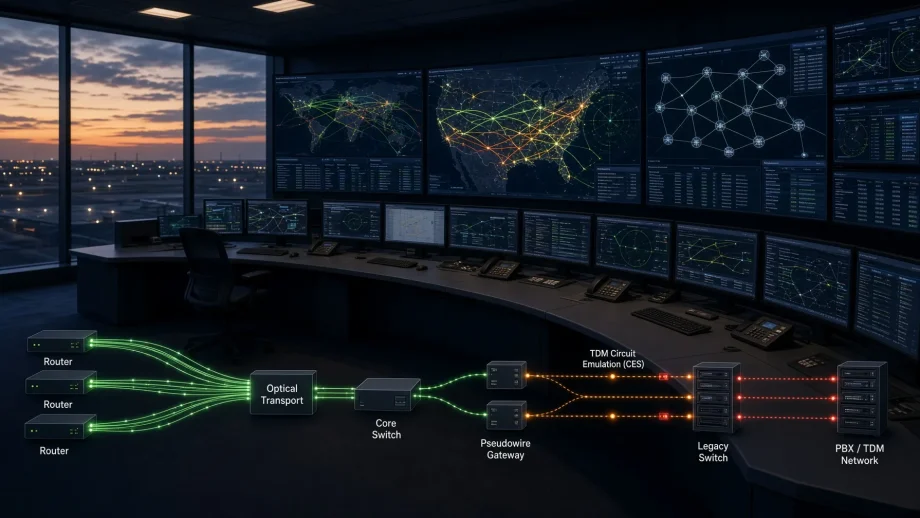
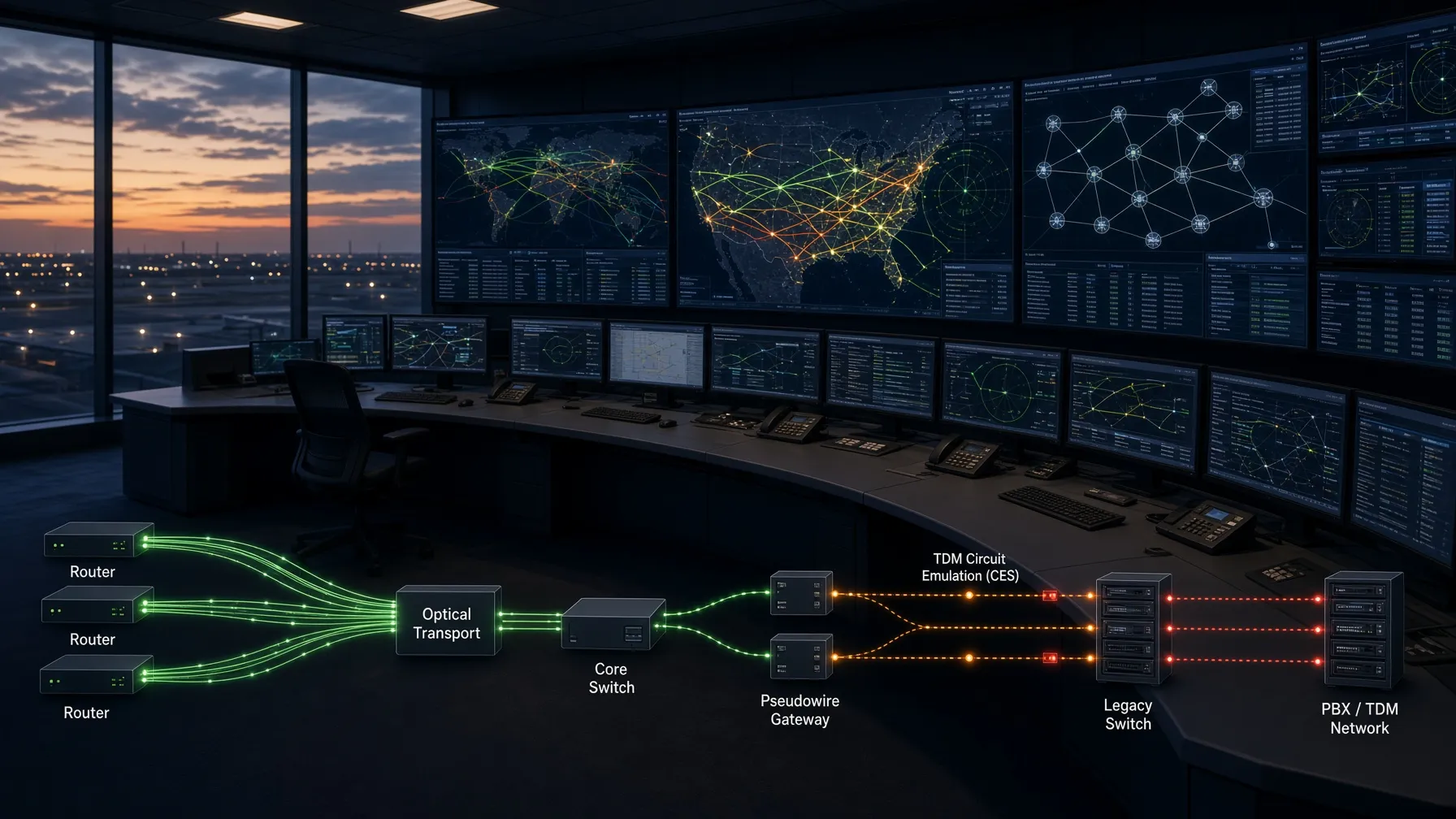
The FTI backbone that L3Harris has run since about 2002 is a hybrid system in the middle of a forced transition. Carriers are sunsetting pure TDM. So a large fraction of remaining TDM services are now emulated over packet—pseudowires, circuit emulation (CESoPSN, SAToP, TDMoIP, etc.). L3Harris has publicly said more than half the paths were modernized by May 2026 and roughly 70 percent of sites or fiber connections were upgraded by early November. Radar data (sensors to ERAM/STARS) and controller voice (facilities to remote radios) both ride this shared backbone. One gateway, control-plane, management, or configuration event can degrade both paths across many facilities at once. Simplified view of how residual TDM services ride over the modern packet backbone inside FTI. A problem at the emulation or management layer hits radar and voice together.
Why the “Legacy TDM Overload” Framing Doesn’t Fully Hold
Intermittent data inconsistency at multiple centers simultaneously, followed by relatively fast recovery through configuration fixes or a reboot, looks a lot more like a packet, gateway, or management-layer problem than independent failure of distributed 1980s copper plant. Mullin’s description and the CBS reporting line up with each other better than a pure “old TDM got overloaded” account. Duffy’s framing is not incoherent if you read it as a loose description of hybrid-layer symptoms. It just under-emphasizes the transition and the possibility of a change-related trigger.
ERAM (the en-route automation) finished full deployment around 2012–2015. STARS is also post-2000s. The primary automation platforms are not 1970s or 1980s systems. Residual copper, older radar heads, and voice switches still exist. Calling the whole thing “decades-old analog equipment that simply cannot compete” is directionally true for the residual pieces and politically useful. It is not a precise description of the failure mode that hit tonight.
Competing Explanations and What Would Change the Odds
On current public evidence the highest-probability story is a failed change, patch, or network update on the FTI side that interacted with residual legacy elements or circuit-emulation gear. That fits the CBS multi-source reporting, Mullin’s comments, the speed of recovery, and the known hybrid architecture. A spontaneous pure-TDM hardware failure across many sites at once is less likely. An upstream carrier event is possible but less consistent with the “update/reboot” reporting. Cyber or other malicious activity has zero public evidence hours into the incident and remains low probability for now.
What would move the needle is an official FAA or L3Harris root-cause statement: exact change window, which subsystem, whether a config push or reboot cascade occurred, and confirmation that fully converted IP sites stayed clean. Until then the precise root cause stays moderate confidence. The safety outcome looks solid—airborne aircraft landed under procedure, no public reports of loss of separation—and the absence of cyber indicators is consistent across officials.
Operator takeaway: When you are mid-migration on a critical hybrid network, “the old stuff overloaded” is often a symptom description, not a root cause. The interesting failure is usually at the interworking layer or in the change that touched it.
Funding Context and the Larger Picture
The $12.5 billion in the 2025 One Big Beautiful Bill is real and was described as a down payment for ATC modernization. Further requests in the $30 billion range have been public for months. The $50 billion figure Duffy used tonight is an escalated ask. Prior NextGen-era spending over roughly 25 years sits in the ballpark of the $15 billion number cited. Whether that history counts as “barely anything” is a political judgment. The technical reality is that copper-to-fiber and TDM-to-IP transitions on a national scale are slow, expensive, and full of exactly these hybrid-risk periods. L3Harris has been executing the current modernization at a reported pace of 130–200 new paths per month while keeping the existing network up. That is not trivial work.
The concurrent Microsoft 365 outage (traced by Microsoft to a network capacity upgrade / configuration issue) and the New Orleans tanker–riverboat collision appear unrelated. SMART, the AI-assisted planning tool expanded to all 22 centers a few days earlier, is decision-support only and was ruled out by its vendor.
What This Means If You Run Hybrid Critical Infrastructure
If you operate anything that still has TDM, serial, or other circuit-switched handoffs riding over a packet backbone—whether that’s an ISP, a data center interconnect, industrial control, or air traffic—you already know the pattern. The residual legacy side looks “old and fragile.” The real operational risk during the transition is usually the emulation gateways, the management plane, and the change-control discipline around them. A bad push on Friday afternoon can take both the modern and residual paths down together because they share the backbone.
Tonight’s FAA FTI network outage is a high-visibility reminder. The ground stop was a conservative response to intermittent degradation, not a total blackout. Procedures worked. The open technical question is what exactly saturated or destabilized the hybrid paths, and whether a network update was the proximate trigger. Official logs or a contractor root-cause would settle it. Until then, treat the pure “legacy TDM overload” framing as incomplete. The architecture is hybrid. The interesting failure modes live at the boundary.
If you have production stories from similar TDM-over-IP or circuit-emulation cutovers, the comments are open. Those are the details that usually matter more than the press conference summary.