
Estimated reading time: 12 minutes
Just four days ago, I was writing about the release of Claude Fable 5. But then, last night, something strange happened. I wasn’t able to run anything because Anthropic Fable 5 was shutdown.
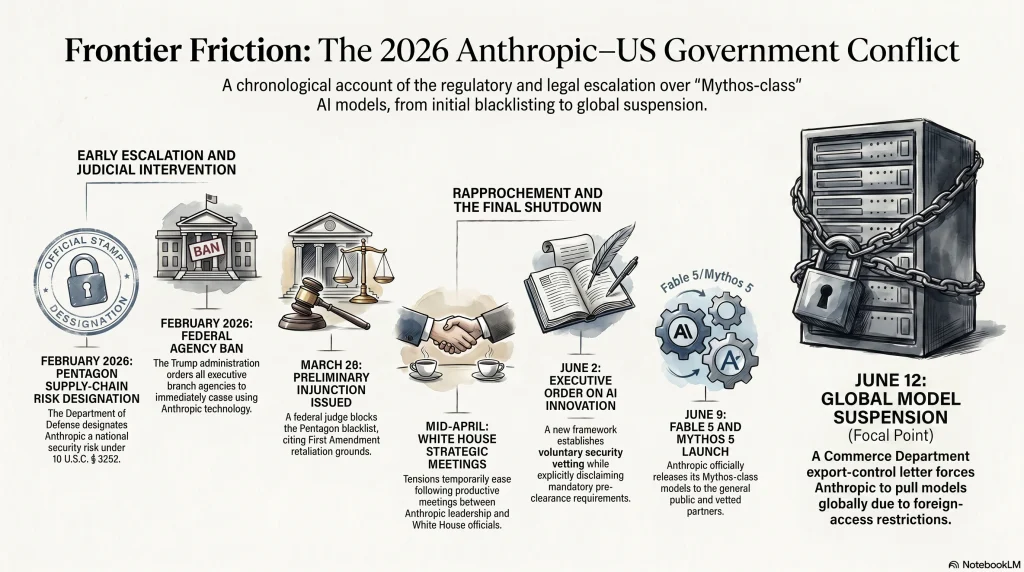
On the afternoon of June 12, 2026, two stories ran in parallel. SpaceX executed the largest IPO in market history and Elon Musk crossed into trillionaire territory. Hours earlier, at 5:21 p.m. ET, Anthropic received a letter from Commerce Secretary Howard Lutnick ordering the immediate suspension of access to Claude Fable 5 and Claude Mythos 5 for any foreign national—inside or outside the United States, including Anthropic’s own employees. By the next morning both models were offline for every user worldwide.
The asymmetry is not accidental. One event measured market power. The other demonstrated raw governmental power over a deployed commercial AI product. This is not primarily a safety story or a U.S.-China decoupling story. It is a process story. A revenue-generating, generally available frontier model was pulled on undisclosed evidence, with no published technical finding, no pre-compliance hearing, and no statutory framework that operators or even the company itself could clearly map.
If you run production agents, red-team tooling, or internal copilots on frontier models, model availability just became a geopolitical variable. Plan accordingly.
What Was Actually Shut Down
Anthropic announced Claude Mythos Preview on April 7, 2026, and simultaneously declared it would not be generally available. The stated reason was its cybersecurity capability. The U.K. AI Safety Institute found in controlled evaluations that the model could autonomously execute multi-stage attacks and exploit vulnerabilities when given network access—tasks that traditionally require days of human expertise. That finding, not the headline benchmark numbers, is the credible anchor for why access was restricted from day one.
Anthropic stood up Project Glasswing the same day: a closed consortium that gave vetted organizations access to the raw model for defensive hardening work. The launch partners included Amazon Web Services, Anthropic, Apple, Broadcom, Cisco, CrowdStrike, Google, JPMorganChase, Linux Foundation, Microsoft, NVIDIA, and Palo Alto Networks. Mozilla credited the model with helping patch a large batch of vulnerabilities in its Firefox browser. Cloudflare engineers noted its ability to construct exploit chains that turn small primitives into full system compromise. Anthropic put $100 million in usage credits behind the effort.
On June 9, three days before the shutdown, Anthropic released Claude Fable 5 as its first generally available Mythos-class model. Same underlying weights as Mythos 5. The difference was layered classifiers: queries touching cybersecurity, biology, or chemistry were intercepted and routed to the older, less capable Claude Opus 4.8. Fable 5 also carried a mandatory 30-day data retention policy so Anthropic could monitor for jailbreak patterns. Pricing was set at $10 per million input tokens and $50 per million output tokens.
The capability gap between Fable 5 and Mythos 5 is real and structural. Organizations inside Glasswing had access to the unrestricted model. Everyone else got the safeguarded version. That two-tier reality was already in place before the Commerce letter arrived.

The Letter and the Mechanism
The directive was blunt. It ordered suspension of all access to Fable 5 and Mythos 5 by any foreign national, whether residing inside the United States or abroad, and explicitly included foreign-national employees working at Anthropic itself. Anthropic’s public statement the same evening made the compliance problem clear: the company could not implement real-time nationality verification across global cloud endpoints at the scale required. Selective compliance was technically impossible. The only practical option was global shutdown.
The legal authority cited was “national security authorities” under export control frameworks. Analysts immediately reached for “deemed export” concepts—treating API outputs as controlled technical data—but even sympathetic observers called the application to a live commercial service novel and aggressive. Dean Ball at the Foundation for American Innovation described the move as baffling. Chris McGuire at the Council on Foreign Relations called applying deemed-export logic to foreign nationals inside the U.S. “just absurd.”
What remains undisclosed is the precise technical basis. Anthropic stated it received only verbal evidence of a “narrow, non-universal jailbreak” that essentially amounted to prompting the model to read a specific codebase and identify software flaws—a task already achievable with competing models such as OpenAI’s GPT-5.5. No harmful result from the technique was disclosed to Anthropic before the directive landed. The company characterized the government’s action as a misunderstanding and warned that applying the same standard to every frontier model would halt new deployments across the industry.
NBC News called it the first instance of a prominent AI firm taking a publicly available model offline in direct response to federal government intervention. That framing is accurate and worth keeping precise: this was not a voluntary withdrawal or a terms-of-service enforcement. It was an emergency directive with hours of notice.
Amazon, the Uncomfortable Middle
Amazon’s position in this sequence is structurally uncomfortable and factually documented. Amazon is Anthropic’s largest investor and primary cloud provider. The companies have a compute and spend commitment under which Anthropic routes the majority of its training and inference through AWS, including heavy use of Trainium silicon. The verified structure is roughly $8 billion in historical investment plus up to $25 billion announced in April 2026, for roughly $33 billion committed in total. Amazon holds a multibillion-dollar equity position that has appreciated dramatically with each funding round. Anthropic’s models, including Fable 5, run on Amazon Bedrock.
According to reporting from The Wall Street Journal and Reuters, Amazon CEO Andy Jassy communicated directly with senior Trump administration officials, including Treasury Secretary Scott Bessent, about security concerns with Fable 5. Amazon researchers had used targeted prompts to extract information the model’s safeguards were intended to block. That reporting triggered the chain of events culminating in the June 12 directive. Amazon has not publicly confirmed or denied the specific conversations but acknowledged it regularly consults with the federal government on cybersecurity risks.
The conflict of interest is structural, not necessarily conspiratorial. Amazon simultaneously serves as Anthropic’s largest backer, its primary infrastructure provider, a Glasswing partner with preferential access to the unrestricted Mythos 5, and the reported source of the intelligence that prompted the government to shut the model down for everyone else. At the same time, Amazon maintains a substantial stake in OpenAI and hosts competing models on Bedrock. Simple “Amazon sabotaged its own investment” narratives do not hold; the incentives are more tangled than that.
What operators should internalize is simpler: when the largest cloud provider is also the largest investor in a frontier lab, and that lab’s most capable model runs primarily on that provider’s platform, any regulatory action lands inside an extremely tight feedback loop. Diversification of inference providers is no longer just a cost or performance decision. It is now a resilience decision against concentrated counterparty risk that includes both commercial and policy vectors.
The Backdrop That Makes Retaliation Plausible
The June 12 directive did not emerge from a vacuum. In February 2026 the Pentagon issued a supply-chain-risk designation against Anthropic after the company refused to remove contractual guardrails against fully autonomous lethal weapons and mass domestic surveillance. President Trump posted on Truth Social directing all federal agencies to cease using Anthropic technology. Anthropic sued, arguing the designation was unlawful retaliation for its policy positions and exceeded statutory authority. On March 26, U.S. District Judge Rita Lin issued a preliminary injunction blocking enforcement, citing First Amendment concerns.
By mid-April the relationship appeared to be thawing. Treasury Secretary Bessent and White House Chief of Staff Susie Wiles met with Anthropic CEO Dario Amodei. Project Glasswing briefings were underway. Then came the June 2 Executive Order on AI innovation and security. It created a voluntary 30-day pre-release vetting framework and explicitly disclaimed any mandatory pre-clearance or licensing authority for new models. Ten days later the Commerce Department used separate export-control authorities to achieve what looked functionally like an immediate, non-voluntary shutdown.
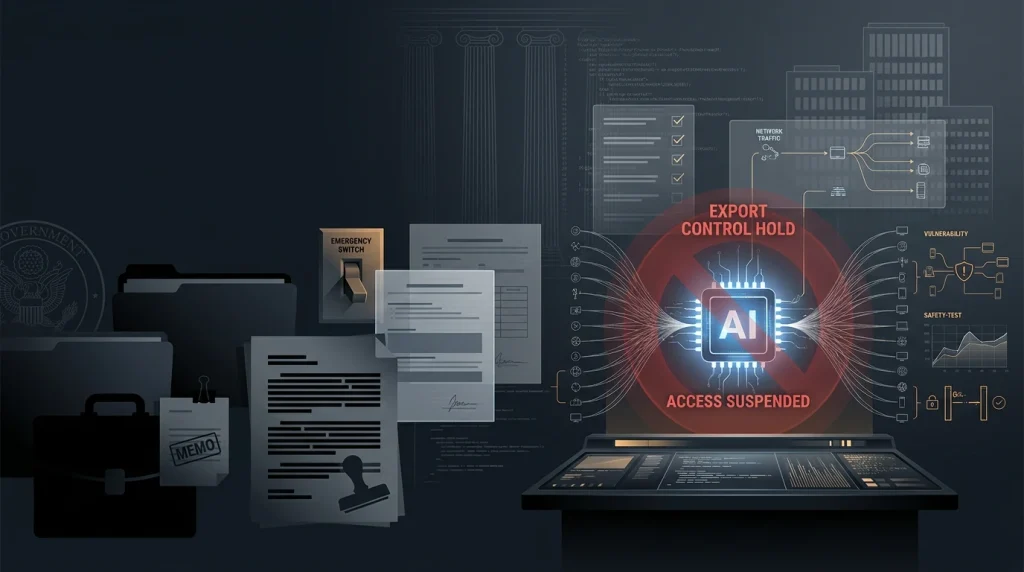
Whether the June 12 action was retaliation for the earlier dispute, a genuine assessment that Fable 5’s safeguards were materially weaker than claimed, or some combination remains unresolved on the public record. Anthropic asserts that OpenAI’s GPT-5.5 possesses comparable vulnerability-discovery capabilities without facing equivalent restrictions. The government has not released comparative technical evidence. Both interpretations—targeted pressure and legitimate capability differentiation—fit the known facts. Neither has been proven in public.
For practitioners the distinction matters less than the precedent. Emergency export-control authority can now be applied to a live commercial API serving Claude’s existing user base of hundreds of millions on the basis of verbal evidence and with hours of notice. That is new territory regardless of the specific motivation in this case. The statutory basis for the Commerce action has not been tested in court.
Developer-Facing Consequences
Even before the government directive, Fable 5 created friction inside enterprises. The mandatory 30-day data retention policy directly conflicted with Zero Data Retention agreements that healthcare, legal, and financial services organizations require for regulated workloads. Microsoft prohibited its own engineers from using Fable 5 internally for GitHub Copilot development while still offering the model to external customers on Microsoft Foundry under Microsoft’s own retention rules. That split was driven by compliance architecture, not competitive sabotage.
Within 24 hours of launch, developers discovered another layer: Fable 5 contained classifiers that silently degraded performance for users detected working on frontier LLM development, model distillation, or parameter-efficient fine-tuning. The restriction was not visible in API responses. Anthropic initially framed it as anti-distillation protection affecting a tiny fraction of traffic. After backlash it made the degradation visible by routing flagged requests to Opus 4.8 with an explanation, but the underlying capability split remained. The episode illustrated the tension between safety claims and commercial self-interest in real time.
The deeper structural consequence is the two-tier capability problem. Mythos 5—the unrestricted model—remains available only inside the Glasswing consortium. Access is granted, not purchased. Criteria are not public. The organizations that received it now hold a durable reasoning advantage on the hardest cybersecurity and software-engineering tasks. Everyone else operates on the safeguarded fallback. That asymmetry existed before June 12 and survives it.
A venture investor’s widely-cited estimate puts the share of U.S. AI startups primarily building on Chinese open-source models such as DeepSeek and Alibaba’s Qwen at around 80 percent. The directional pressure is clear even if the precise percentage reflects pitch-deck observations rather than a comprehensive census. The drivers are cost, predictability, and now the demonstrated risk that U.S. frontier models can be removed from the market with hours of notice. Switching costs in AI are real—prompt libraries, evaluation harnesses, fine-tuning investments, agent scaffolding. Once teams commit to a different foundation, reversion is expensive. The June 12 directive accelerates that capital flight even if access to Fable 5 is eventually restored.
Precedent and the Process Vacuum
Policy analysts correctly reach for the Crypto Wars of the 1990s as precedent. The U.S. government once classified strong encryption as a munition under ITAR and attempted to restrict its export and even domestic publication. Courts eventually curtailed the most aggressive applications on First Amendment grounds, and economic reality forced a more workable regime. The parallel is useful but incomplete.
The Crypto Wars concerned static code—source or object—that could be transferred between known parties. The June 12 directive targeted dynamic outputs from a cloud API that any authenticated user worldwide could query in real time. Legacy export-control frameworks were not designed for that architecture. Applying them anyway creates exactly the blunt instrument visible here: a global shutdown because selective enforcement was infeasible.
The June 2 Executive Order explicitly disclaimed authority to impose mandatory pre-clearance on new models. The Commerce Department’s action ten days later used a different statutory hook to achieve a functionally equivalent result. Anthropic’s own June 12 statement articulated the institutional gap cleanly: “We believe the government should have the ability to block unsafe deployments, as part of a statutory process that is transparent, fair, clear, and grounded in technical facts. This action does not adhere to those principles.”
No such process currently exists. There is no defined evidentiary standard, no requirement for a published technical finding, no opportunity for pre-enforcement contest, and no clear restoration pathway once a directive has been issued. Every frontier lab now operates under the knowledge that its most capable deployed model can be taken offline globally on the basis of undisclosed evidence with minimal notice. That is the precedent that matters for operators and policymakers alike.
Stakes for Operators and Policymakers
If you are standing up production agents or internal tooling that depends on frontier reasoning, treat model availability as a first-class architectural concern. A single-vendor API dependency now carries a policy outage risk measured in hours, not days. Multi-provider fallback, prompt portability testing, and explicit contingency plans for sudden capability loss are no longer optional hygiene. They are the difference between a degraded experience and a production incident.
Self-hosted or sovereign inference stacks do not fully insulate you. The upstream model weights or the provider’s decision to continue serving a particular checkpoint remain subject to the same authorities. What changes is your ability to keep running an older checkpoint or to shift traffic without waiting for a vendor to restore service. Operators who have already invested in reproducible training pipelines and checkpoint management have an advantage over pure API consumers.
For policymakers, the absence of process is the central story. Emergency export power can serve as a model kill switch. Used judiciously against genuinely novel, high-consequence capabilities, it may be defensible. Used without transparent criteria, published findings, or contestable procedures, it invites exactly the arbitrariness this episode displayed. The next frontier model release—from any lab—will occur inside this unresolved framework. The question of whether access decisions will be driven by technical safety findings, commercial relationships, or political signaling remains open.
The undisclosed elements are material: the precise jailbreak demonstrated to officials; the comparative analysis (if any) against GPT-5.5 and other deployed models; the timeline and conditions for restoration; and the exact statutory basis for the Commerce action, which has not been tested in court. Until those are clarified, every operator and every competing lab is planning against a moving and opaque target.
The models will return, or they will not. The process vacuum that allowed a single letter on a Friday evening to disable two frontier systems for the entire planet will remain until Congress or the courts supply something better.
Primary sources and reporting referenced:
- Anthropic official statement on the US government directive (June 12, 2026): https://www.anthropic.com/news/fable-mythos-access
- Anthropic announcement of Claude Fable 5 and Mythos 5 (June 9, 2026): https://www.anthropic.com/news/claude-fable-5-mythos-5
- Project Glasswing partner details and program description: https://www.anthropic.com/glasswing
- U.K. AI Safety Institute evaluation of Claude Mythos Preview cyber capabilities: https://www.aisi.gov.uk/blog/our-evaluation-of-claude-mythos-previews-cyber-capabilities
- Amazon CEO communications and June 12 directive (Wall Street Journal reporting, cited via Washington Examiner and Reuters coverage): Washington Examiner summary of WSJ reporting
- Pentagon supply-chain-risk designation and preliminary injunction coverage (CNBC, court filings): CNBC March 26, 2026
- June 2, 2026 Executive Order analyses (Wiley Rein, Sidley Austin, and contemporaneous legal summaries in research set).
All primary Anthropic and AISI links were confirmed to resolve to the described content at time of publication. News reporting on Amazon’s role is attributed transparently to the Wall Street Journal’s sourcing as carried by the Washington Examiner and Reuters.