


Evidence through 1:00 p.m. Eastern, November 15, 2026.
What caused the FAA ground stop was L3Harris work installing a new router at a remote radio site in El Dorado, Arkansas. The router began broadcasting into the network. Routers at 17 of 22 en route centers could not contain the load. The nationwide stop ran from 3:54 p.m. to 8:15 p.m. Eastern. That is the account that emerged over the weekend, and it holds. It replaced Friday night’s story without anyone saying so. I covered the first night and the hybrid TDM-over-IP architecture in my first-night analysis of the FAA FTI network outage. This post answers what three days of official accounts and outside reporting now show about the FAA ground stop root cause.
What Happened on November 13
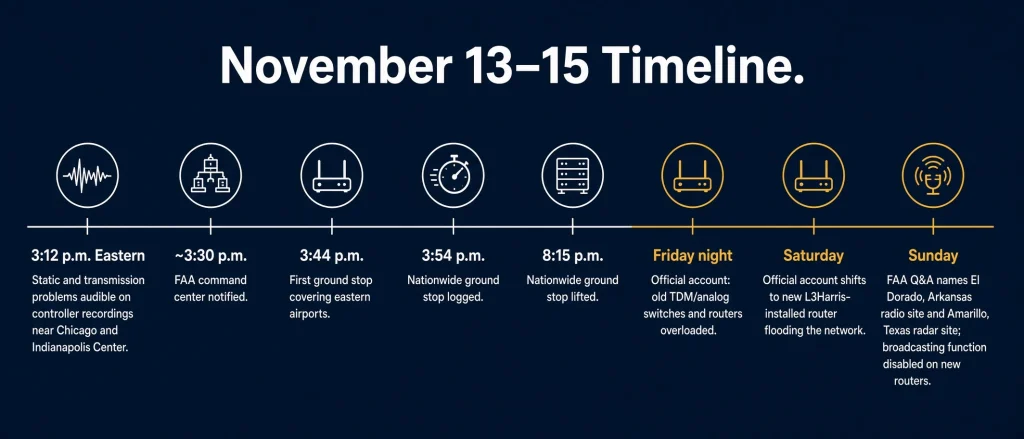
Recorded controller audio has static and transmission problems by 3:12 p.m. Eastern near Chicago, Indianapolis Center, and elsewhere. The Wall Street Journal reported that glitches were first noticed at Indianapolis Center. The FAA command center was notified around 3:30. A first ground stop covering eastern airports came at 3:44. The nationwide ground stop was logged at 3:54 p.m. It lifted at 8:15 p.m. Roughly 3,500 aircraft were aloft when the stop began. They continued to their destinations under existing procedures. The FAA counts about 12,462 cancellations that day, 9,082 of them by major airlines.
The symptoms were intermittent degradation, not a hard blackout. Voice and radar data both became unstable because they share the same transport. Towers, which depend less on long-haul circuits, were less affected. That pattern is consistent with a problem in the shared backbone, not independent failures of local equipment.
Three Days, Three Official Accounts
Friday night the White House briefing blamed old TDM and analog switches and routers overloaded with data. Secretary Duffy restated that account when asked whether FAA patching caused the outage. Secretary Mullin said new equipment and patches had overwhelmed the older system. CBS had already reported a network update. Bloomberg had reported an FBI inquiry into a software update. CNN had reported a single point of origin. None of that appeared in the official account that evening.
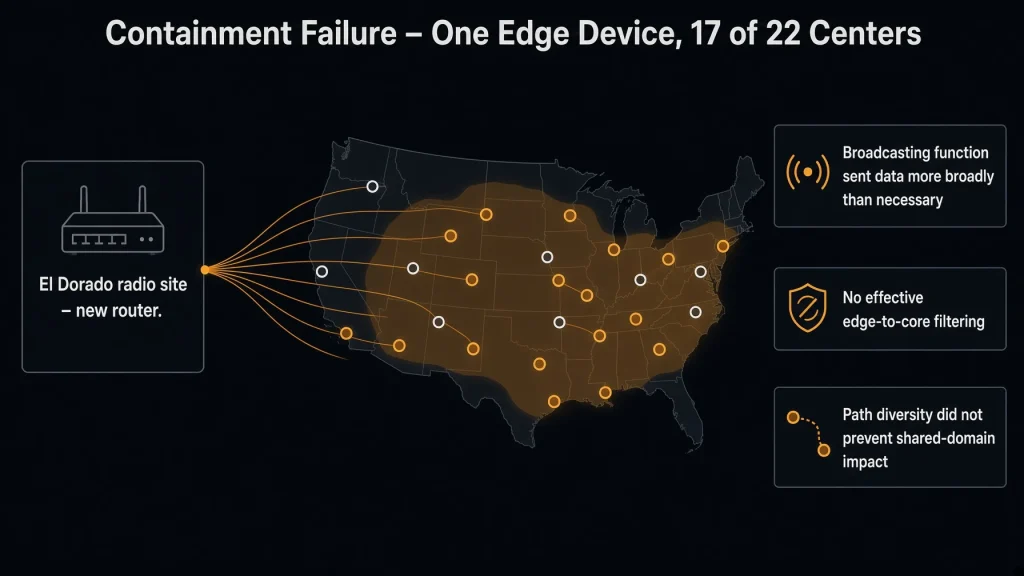
Saturday the Transportation Secretary and the FAA Administrator blamed a router newly installed by contractor L3Harris at a remote site. The new router flooded other routers with more than 1,000 connection attempts every four to five seconds. The work was described as routine copper-to-fiber maintenance. Sunday the FAA’s written Q&A named the site El Dorado, Arkansas, and said it had switched off a broadcasting function on the new routers and about 60 similar ones. A second router at Amarillo, Texas, had run for three weeks without incident and flooded only when the El Dorado unit was turned on. The Wall Street Journal reported that officials traced the overload to a feature that sent data more broadly than necessary.
The account changed twice. No one has said Friday’s cause was wrong. Confidence language moved closer to the evidence each day. Friday called the cause very easy. Saturday said officials felt very comfortable that was the root cause. Sunday said they do not actually have the root cause. The routers are in a contractor’s lab. HPE says the devices did not fail. L3Harris says it is supporting the investigation. PASS, the technicians’ union, pointed to the El Dorado work.
What the Router Actually Did
A thousand events every four to five seconds is 200 to 250 per second. That volume is trivial for forwarding. It can flood a router only if each event costs processor time on the control or management plane. Saturday the speakers described the events three ways: connection attempts, logon attempts, and pinging. Sunday the FAA said it disabled a broadcasting function on the new model. Read as control-plane load on older routers with no protection against it, the account works.
The broadcasting function fits a multicast or probe feature that was on by default in the new model. Officials told the Journal the feature sent data more broadly than necessary. Disabling it fleet-wide resolved the issue. We put the chance that a broadcast-type function on the new router model produced the flood at 70 to 85 percent.
Two routers matter. Amarillo joined only when El Dorado came up. That fits a function in which routers of the new model find or answer one another. It fits a single hardware defect poorly. The maker says the devices worked as intended. Against the roughly 2,000 routers being replaced, 60 to 69 of this model means the replacement is about 3 percent complete. The new routers are from Juniper Networks (an HPE company).
Why One Router Is Not the Root Cause
The trigger is well supported. The FAA’s written Q&A, the technicians’ union, and the Journal all point to the El Dorado work. The chance that the trigger is L3Harris installing a new router at El Dorado is 90 to 95 percent. The deeper failure is containment. One edge device should not be able to disturb routers at 17 of 22 en route centers. Secretary Duffy said its broadcasts went to all of the other routers. That requires a shared domain with no effective filtering between edge and core. The redundancy listed is path diversity. Path diversity does not help when every path shares one failure domain. A containment weakness beyond the device was necessary at above 95 percent.
Detection also failed. Administrator Bedford described 45 minutes without a diagnosis. Ms. Guy said the sources were disabled right away. No one has said when the source was found. A source producing abnormal session or probe traffic should stand out in centralized logs within minutes if those logs exist and are watched. Whether the change was recorded in the FAA’s electronic system or only in the contractor’s records is not established. The job ran on a Friday afternoon, 13 days before Thanksgiving. Remote sites are done by day. The FAA says it will reevaluate when it does such work.
This Has Happened Before
On November 19, 2009, 129 air traffic facilities lost service after a Harris technician misconfigured a router at Los Angeles Center while placing a new router in service on the FTI fiber network. It was the same network, the same contractor lineage, and the same kind of work. The Inspector General recorded that the FAA and Harris took corrective actions meant to prevent another critical outage. Ms. Guy said the FAA did not know this was possible. Secretary Duffy said Sunday that this has never happened. The 2009 outage is the same class of event. What changed after 2009, and whether those changes were in place on Friday, remains open.
Would More Funding Have Prevented It
Friday blamed old equipment and Congress. Saturday and Sunday blamed L3Harris or its router, Congress, and earlier administrations. Administrator Bedford said the job is not part of the $12.5 billion effort.
The strongest version of the officials’ argument is that the FAA is doing live surgery on a network it should have retired. Carriers are discontinuing the copper circuits, which forces the pace. Roughly 30 percent of about 5,170 connections are still to be cut over, so the exposure continues until the replacement is finished.
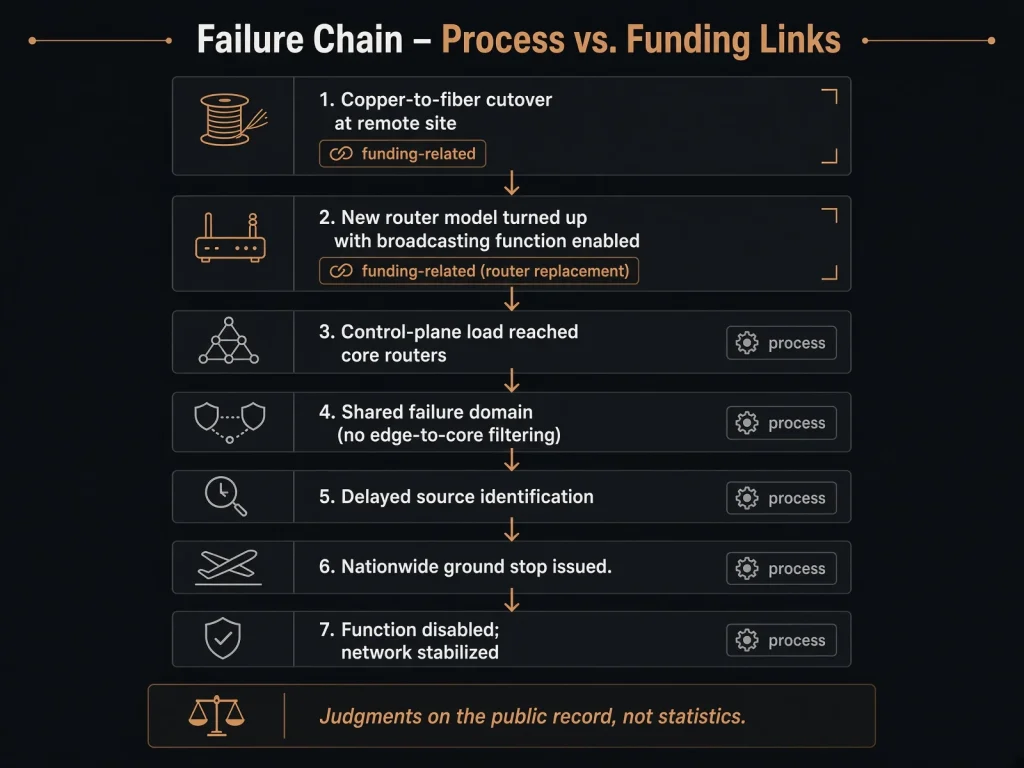
The strongest objection is that this was a failed change in routine sustainment, by the incumbent contractor, under money the FAA already has. About 38 percent of the $12.5 billion is committed. The same class of failure occurred in 2009. Of seven links in the failure chain, two depend mainly on funding: retiring the legacy network sooner and replacing old routers. Five are process: scheduling, pre-testing, change records, monitoring that can name a source, and edge-to-core filtering. The chance that the requested money would have prevented Friday is 10 to 20 percent. These probabilities are judgments on the public record and not statistics.
What I Got Right and Wrong on Night One
In my first-night analysis of the FAA FTI network outage I said pure TDM does not fail by statistical data overload. That holds. TDM is circuit-switched. Fixed timeslots do not congest. The devices that overload are routers. I also said the highest-probability story was a failed change or update on the FTI side interacting with residual legacy elements. That is now the weekend account. Mullin’s version on Friday was closer to the later record than Duffy’s pure overload framing. The timing I used, instability around 3:36 and the stop at 3:54, matches the logged nationwide stop but is later than the audio record of trouble by 3:12. The aircraft count of roughly 3,500 was in the right range. The absence of public evidence for a cyberattack has held; the chance of no malicious involvement is 95 to 98 percent. What the first post could not yet see was the named site, the broadcasting function, the second router, and the blast radius.
What We Still Do Not Know
Ten questions remain open or only partly answered. What exactly was the new router sending, and what failed on the routers that received it? Why could one edge device reach core routers at 17 of 22 centers? Who approved the change, under what window rules, and where was it recorded? When was the source isolated? Which five centers were unaffected, and why? What functionality was shut off on about 60 routers? What changed after the 2009 outage? Was the router examined forensically, and will the FBI or CISA put a finding in writing? How many copper cutovers remain before Thanksgiving, and under what rules? The FAA knew of the link to the work before Friday’s briefing at 85 to 93 percent. What either secretary personally knew is not established.
What This Means If You Run a Network
Five lessons.
- An edge device that can reach the core is a design problem, not a hardware problem. Filtering and scoping between remote sites and the core is the containment that failed here.
- A broadcasting or probe function that is on by default in a new model will find every peer it can reach. Review feature defaults before the first turn-up.
- Change records that exist only on paper, or only in the contractor’s system, are invisible when the network is already unstable. Centralized logs that can name a source in minutes are part of the fix.
- Path diversity does not protect against a shared failure domain. If every path shares the same routing domain or the same hubs, you have one infrastructure.
- The base rate of a routine job done thousands of times is low. When it fails, the question is what was different about this job. Here it was a new router model with a broadcasting function enabled.
FAQ
Was the FAA ground stop a cyberattack?
Officials on all three days cited recovery when the sources were isolated, the FBI’s presence, and no chatter. The chance of no malicious involvement is 95 to 98 percent. The routers are still being examined. There is no written finding from the FBI or CISA.
How long did the FAA ground stop last?
The nationwide stop was logged at 3:54 p.m. Eastern and lifted at 8:15 p.m. That is roughly four and a half hours. Trouble was audible in controller recordings by 3:12. A first eastern stop came at 3:44.
Who runs the FAA’s network?
L3Harris has managed the FAA Telecommunications Infrastructure since 2002. The network links more than 4,400 facilities. The new routers are Juniper Networks (HPE). Cisco engineers are also assisting the diagnostics on the older gear.
Could it happen again?
Secretary Duffy said he could not guarantee it will not. The same class of event occurred in 2009. Roughly 1,500 jobs of this kind remain as copper cutovers continue. The FAA says it will reevaluate when it does such work.